AI Just Solved A Problem Without Ever Learning It
An OpenAI model disproved a problem that stumped every human who tried for 80 years. The model was never trained on the answer. Nobody knew the answer. The machine found something that did not exist before it looked.
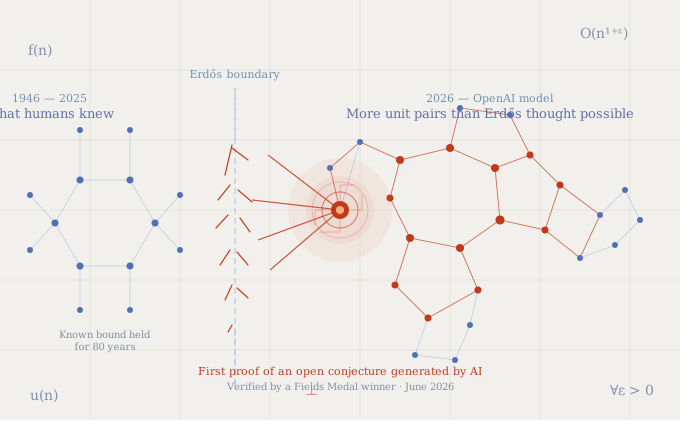
An unreleased OpenAI reasoning model has disproved the Erdős Unit Distance Conjecture. The problem is 80 years old. Every serious attempt to crack it failed. An independent panel of mathematicians, one of them a Fields Medal winner, checked the AI's proof, and it holds.
There were a few media reports about this advancement, but almost all of them miss the part that actually matters to anyone watching where this technology is going. AI has finally solved something without learning. The breakthrough also proves that a machine doesn't need to understand a problem to solve it.
What the conjecture actually was
Paul Erdős asked a plain question in 1946. Take a large set of points on a flat surface. How many pairs of those points can sit exactly one unit apart from each other? He believed the answer was far smaller than geometry would suggest. That was a guess and later came to be known as the conjecture.
The Erdős conjecture is not famous because it is hard to understand. It is famous because it was hard to advance. Mathematicians knew roughly what the answer looked like for decades. But getting from intuition to proof required a move that no human could make.
OpenAI apparently solved it.
The OpenAI model did not prove Erdős right. It proved him wrong. It found an arrangement of points where unit-distance pairs exceed what Erdős thought possible. That is the result.
Why this was supposed to be impossible for AI
Every time AI has beaten humans before, the game had automatic scoring. The machine could practice endlessly and also get immediate feedback. Pure mathematics has no such scoreboard. That is what kept AI out of original research for so long.
The way through was to use formal proof-checking software as the judge. Tools like Lean and Coq read mathematical arguments line by line and flag invalid steps. When you wired this software in the training process, the model could run millions of proof attempts and get precise feedback on each one. Over time, it learned what kinds of moves lead somewhere.
This had been done before on known proofs, where the answer already existed and the machine was just learning to reproduce it. The Erdős result is different because the answer did not exist. The model was not repeating human work. It was doing something humans had not done.
Where formal proof tools are strong and weak
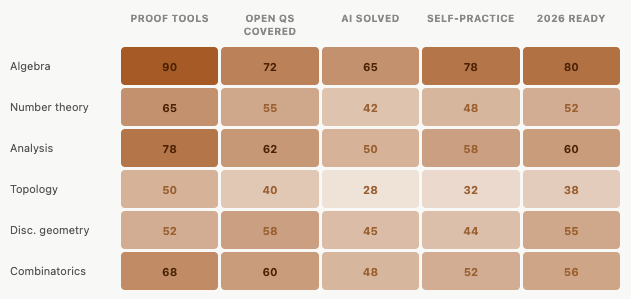
This approach only works in areas of mathematics where formal proof-checking software is mature enough to serve as a reliable judge. The heat map below shows how covered different areas of mathematics currently are. Discrete geometry, where Erdős lived, sits in the middle. That makes what happened here harder than it looks.
Reinforcement learning just left its sandbox
For years, AI systems trained by trial and error worked inside environments designed to be machine-scorable. Each of these had a clear objective that the system could measure itself against. Researchers understood this as a hard limit. Notably, trial-and-error learning needs feedback. Pure mathematics does not give you feedback automatically.
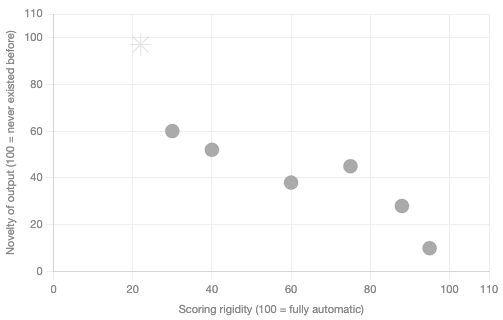
This result is the first time that the limit has been broken at research depth. The scatter plot below puts it in context. The further right a milestone sits, the less rigid and automatic the feedback was. The further up, the more genuinely new the output. The Erdős disproof sits alone in the top right. To understand the architecture that made this possible, the piece on how transformers actually work is worth reading before anything else.
How fast this capability has moved
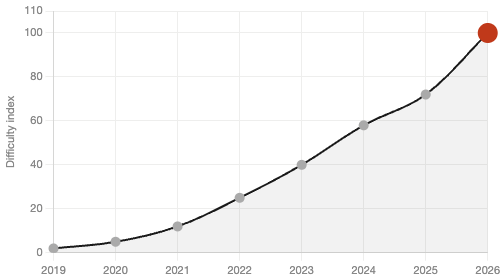
AI's math ability has not been static. It passed university-level problem sets around 2022 and accelerated sharply in 2024 as labs connected these models to formal proof tools. The Erdős result is where that climb crossed into original research. The line chart below tracks the difficulty of problems AI could solve each year, indexed roughly against how long human experts would need to crack them. The jump from 2024 to 2026 is jaw-dropping.
What feeds into these models matters as much as the architecture. The piece on why your data pipeline matters more than your prompt explains why the quality of mathematical training data is as consequential as the model design itself.
The model is not available
OpenAI has not released the model that solved it, and there is no timeline given either. Only the outcome and the verification have been made public for now.
Speculation about what else it can do is already running ahead of the evidence. Solving one problem in discrete geometry does not mean the approach works across all of mathematics. Areas like number theory and topology would need mature formal proof tools before this method becomes viable there. In many cases, those tools do not yet exist at the required quality.
A working method has been demonstrated on a real open problem. That is new. How far it extends will take years to find out.
From the Editor's desk
The breakthrough does not mean mathematicians are being replaced. Mathematicians decide which questions are worth asking, build entire new fields, and develop the intuition that guides research for decades. None of that is what happened here.
It does not mean AI can now solve any hard math problem. Most areas of mathematics are still thin on formal proof tooling. Without that, the approach breaks down.
What it does mean is that AI produced a mathematical result that did not exist before and that human researchers could not produce in 80 years. For the first time at research depth, the output is not a summary of what humans already knew. That line has been crossed, and the consequences of crossing it will take time to fully understand.
If you want to understand how AI systems decide what to cite and credit when they surface results like this, the guide on schema markup for AI citation is a practical place to start. For the broader picture of who the AI capability shift is actually reaching, the map of the AI future puts this result in the right frame.
Want to flag an error or add context? Reach out via gptfrontier.com.