The Map of the AI Future Is Already Drawn. Most of the World Isn't On It.
Microsoft's Q1 2026 Diffusion Report shows the UAE at 70% adoption and the Global South at 15%. The gap subtly highlights the new geography of the global economy.
Microsoft's Global AI Diffusion Report, released this week, settles an argument the industry has been having with itself for three years. Generative AI is no longer a promising technology waiting for mass adoption. In parts of the world, it is already infrastructure. In other parts, it is barely present.
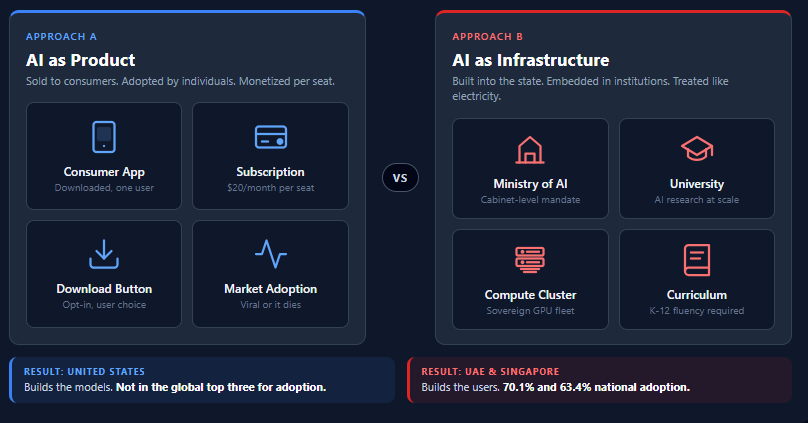
The headline finding is the UAE. 75.1% of its working-age population uses generative AI regularly. Singapore follows at 63.4%. Norway sits third at 48.6%. The United States, which produces most of the world's frontier models, is not in the top three. That fact alone deserves a potential congressional hearing.
How the Gulf Got Here
The UAE's position is the result of a decade of deliberate policy. Abu Dhabi appointed a Minister of State for Artificial Intelligence in 2017, before most Western governments had a coherent position on language models. It founded Mohamed bin Zayed University of Artificial Intelligence in 2019. It has underwritten domestic compute, courted chipmakers, and funded the Falcon model family through the Technology Innovation Institute.
The World, Redrawn by AI
Countries sized by generative AI adoption rate, not by landmass. The UAE becomes a continent. Much of the Global South barely registers.
Singapore's number reflects the same pattern. Government, industry, and education aligned early and moved together. When a state treats a technology as national infrastructure rather than a consumer product, diffusion stops resembling a market and starts resembling electrification.
Washington has been building the models. Abu Dhabi and Singapore have been building the users. The Microsoft data suggests that in the 2020s, the latter matters more.
The Gap That Will Define the Decade
Global North adoption now stands at 27.5%. Global South adoption sits at 15.4%. A twelve-point gap would be a rounding error in most economic indicators. In AI diffusion, it is the outline of a two-tier global economy.
The digital divide of the 2010s concerned connectivity. A person without broadband could not fully participate in the internet. The AI divide is worse because it compounds. Workers using AI produce measurably more output per hour in tasks ranging from legal drafting to code review to medical documentation. That productivity differential does not stay local. It shows up in wages, in foreign direct investment decisions, in where multinational firms locate their knowledge work.
A lawyer in Lagos drafting a contract without AI assistance now competes with a lawyer in Oslo who can produce equivalent work in a fraction of the time. A clinic in rural Bolivia without AI-assisted diagnostic tools operates under a different standard of care than one in Dubai. These are not hypothetical scenarios, but are already reflected in outsourcing contracts being renegotiated this quarter.
What Microsoft Leaves Out
The countries at the top of this list are not necessarily the ones with the strongest data protections, the clearest labor protections for workers affected by automation, or the most democratic processes for deciding how AI gets deployed in public services. They are the ones that moved fastest.
That is worth naming. High adoption can reflect empowerment. It can also reflect workplaces where refusing to use AI is no longer a viable choice. Microsoft's report measures diffusion. It does not measure whether workers using AI have any meaningful say in how it is deployed against them. European regulators will notice. American and Asian regulators should too.
What Catching Up Actually Requires
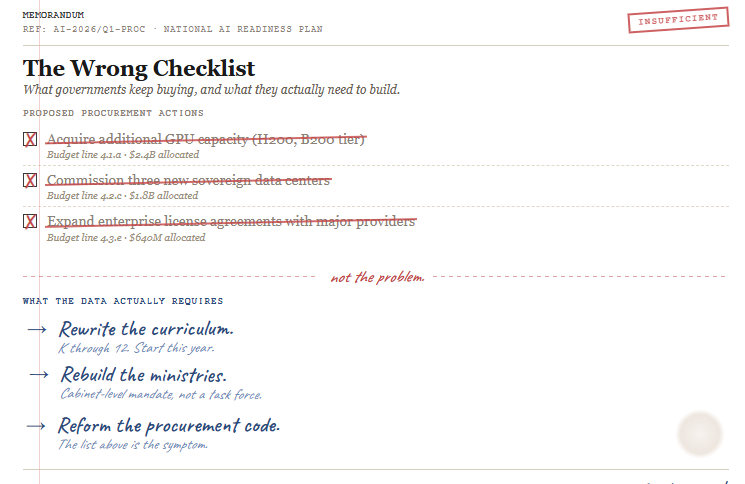
Leaders in lagging economies will read this report and reach for the familiar playbook. More cloud credits. More data center incentives. More subsidized enterprise licenses. That response will not close the gap.
The UAE did not reach 70% adoption by buying more compute. It rebuilt its public institutions, its school curricula, and its regulatory posture around the assumption that AI would be central to economic life. That is expensive, politically difficult, and slow. It is also the only approach the data supports.
The familiar consolation offered to lagging economies across three decades of technology waves has been that the next wave will be the one that closes the gap. Mobile phones were supposed to leapfrog landline infrastructure. Cloud computing was supposed to democratize software. Some closure occurred each time, and each time the frontier moved further out. Generative AI is moving the frontier faster than any previous wave.
Microsoft's report is a map of where the world is going. It is also a list of who is being erased from it.
The window for meaningful action has not closed. On the Q1 trajectory, it is closing faster than most governments outside the top three appear to understand.
References
- Microsoft Corporation, Global AI Diffusion Report, Q1 2026, Microsoft Work Trend Index, May 11, 2026.
- Stanford Institute for Human-Centered Artificial Intelligence, AI Index Report 2026, Stanford University, 2026.
- United Arab Emirates Government, UAE National Strategy for Artificial Intelligence 2031, Office of the Minister of State for Artificial Intelligence.
- Mohamed bin Zayed University of Artificial Intelligence, institutional profile and research output summary.
- OECD, AI Policy Observatory, Country Dashboards.
- McKinsey Global Institute, The Economic Potential of Generative AI, revised edition, 2025.
- World Bank, Digital Development Global Practice, AI and Inclusive Growth Working Paper, 2025.
- Technology Innovation Institute (Abu Dhabi), Falcon Model Family Technical Reports.
The opinions expressed in this editorial are those of GPT Frontier's editorial board.